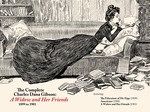
Here's something we weren't expecting! The Complete Charles Dana Gibson: A Widow and Her Friends is a very nicely produced, Smyth-sewn bound, 224 page, horizontally-formatted, oversize (12" x 9") hardcover that is crisply printed (in China by Shanghai KS Printing, Inc.) on excellent paper stock – at such an attractive price that it makes it nigh on irresistible to anyone with more than a passing interest in Charles Dana Gibson, creator of the "Gibson Girl" and perhaps the most famous American illustrator at the dawn of the 20th century.
It collects three works that were published, as the sub-title implies, between 1899 and 1901 – literally at the turn of the century – each of which is composed as a series of full page captioned drawings – balanced on the facing page by portrait drawings, largely of the featured characters – that – at least in the cases of The Education of Mr. Pipp and A Widow and Her Friends – gradually cohere into a comprehensible story, a now somewhat archaic form that dates from the 18th century (if not before) and that Gibson sharpened and polished with his laconic wit – and, of course – amazing drawing chops, for which he was, and continues to be, justly renowned. Americans Drawn by C.D. Gibson along with most of the rest of the book is devoted to full page drawings, most with witty captions and/or dialogue, some without.
So, here's a book rich in comics history and packed with high calibre illustrations, yet it is a work that clearly grew out of an upper crust soil quite different from the earthy loam from whence sprung the hearty creations that form the primary lineage of comics. Gibson's comics here are – more or less – of the wealthy, by the wealthy and for the wealthy, that, quite deliberately, stood apart from the rest, and, one suspects, looked down on them (preserving some "Gilded Age" attitudes in ink, and so providing further resonance for today's readers living throughwhat may prove to be an even more gilded age). Yet, it is intriguing to realize that the works contained in this volume were created at the same precise moment that comics were first materializing in the newspapers geared for the masses and that it was these newspaper comics that proved to have the far greater vitality and that went on to form the basis for the comics industry we have today, while the "higher quality" "higher class" comics by Gibson collected here left very little in the way of legacy – apart from the technical proficiency and stylistic idiosyncrasies of the work, and, of course, the objectification of female beauty that was embodied by "the Gibson girl."
There is also a heavily illustrated introductory essay by series editor, Sean Michael Robinson. Yes, you heard that right: this is only the first of a multi-volume series; those for whom this book is a treat, have more to look forward to!
Temporarily out of stock. Please check back in, say, late July...