Richard Hell can certainly count himself among the founders of punk rock; if anyone can be credited with pioneering the spiky hair, ripped T-shirt and safety pin look that became the visual hallmark of punk, it is Richard Meyers, who most know and love – or hate, or love to hate, or hate to love – as Richard Hell. Of course, there is much more to punk than the pose, and Richard Hell was in at the birth of the form, singing, writing songs, and playing bass with, first and foremost, Tom Verlaine (née Miller) in the original Television, as one of The Heartbreakers with legendary rock martyr Johnny Thunders, and, perhaps most importantly, fronting the Voidoids with guitar-master Robert Quine. Between these two covers, we get his take on his punk years and more. Richard Hell has been considering himself more of a writer than a musician for quite a while now, and not without reason: he has developed a cogent and readable style that is easily several notches above that found in typical a rock memoir and that is pretty much guaranteed to be of interest to anyone with a yen to learn more about those halcyon punk days; but don't expect another Just Kids.
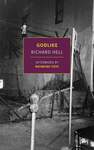
Originally published in 2005 and long out of print, Godlike has now been reissued as a NYRB Classic.
Here's the NYR take on it:
New York poet Paul Vaughn has a trick for enjoying poetry readings: He simply imagines the reader died a long time ago. Paul is twenty-seven, married, and an admired poet himself. R. T. Wode’s mission is to give offense. He’s also a poet, freshly landed in the city, and, at age sixteen, unknown.
Paul worships T. They embark on a tempestuous affair, dropping acid and crashing parties and perambulating the grit and grime of New York City circa 1972. Paul is in love with T., but T. is in love with experience. Their relationship disintegrates.
A novel of compelling originality and transcendent beauty by legendary musician and poet Richard Hell, Godlike transposes the notorious romance of Paul Verlaine and Arthur Rimbaud to the East Village in its squalid, glorious ’70s heyday. The book comprises a version of Paul’s 1997 hospital notebooks: diaries amidst poems and essays, along with, most pertinently, the poet’s third-person memoir-novelette of his youthful time with the now-famous T. Godlike is infused as well with evocations—and sometimes actual poems—of many New York poets of the era, from Ted Berrigan and Ron Padgett to Edwin Denby and James Schuyler. It achieves a lyricism both profane and profound as it conjures the frenetic vitality as well as the existential malaise of an era. It’s a searching meditation on art, life, love, and the impossibility of everything.