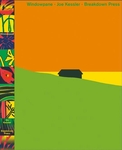
This classic is now back in print is this nice, 384 page softcover edition from New York Review Classics, who have this to say about it:
Winner of the 1972 Booker Prize
Who is G.? The illegitimate son of an Italian candy merchant and a rich young American divorcée, G. is born at the end of the nineteenth century and raised on a farm in England before going on to a Europe that will soon explode in war. G. is a seducer and a cipher, moving from place to place and woman to woman. G. seeks and finds revelation in the shared immediacy of the senses. At the same time, G. is the specter of capitalism’s atomized social world. He experiences the persistence of love and the impossibility of love in the world we have been condemned to live in.
What is G.? A historical novel, a coming-of-age novel, a novel of the transformative and terrifying twentieth century, and a novel exploring all the different things the novel can be, full of stories of men and women, but also of poems, essays, and drawings. It is an inquiry into the nature of sexuality, the strangeness of love, and the inescapable demands of solidarity, a novel that seeks to imagine “a new way of living.” At the center of it an aviator sets out to fly across the Alps for the first time, while a man and woman, lost in their own world, meet for a rendezvous in a hotel. “Never again,” the narrator writes, “will a single story be told as if it were the only one.”
G. is an initial, the beginning of something new.
Additional Book Information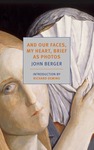
Here's another in the NYRB series republishing of classic John Berger works.
And, here's the NYRB promotional write-up:
And Our Faces, My Heart, Brief as Photos may be the most original of John Berger’s books; certainly, it is among the most moving. A meditation on first and last things, it is divided into two parts, one reflecting on humanity’s relation to time, the other on our place in space. “Once,” the first part is called, and like fairy tales, the sections that follow, encompassing essays, stories, and passages of plainspoken poetry, echo that initial once, as Berger contemplates the ways in which death and love and sex and life revolve around each other in human existence and find expression in art and work and the observances of daily life.
Part two, called “Here,” investigates the idea of home in a world where capitalism has rendered everyone homeless, not only the countless people who, over the last two centuries and ever more now, have been driven by need to leave their native ground for strange cities and suburbs and slums, but also the well-to-do and the rich, content to exchange the reality of home for the fungibility of property. Against such backgrounds, Berger considers the role of storytelling and the power of poetry and painting, and above all—because a letter addressed to the absent beloved resonates throughout the pages of this book—is the renewing and unsettling persistence of love and desire.