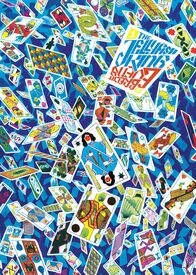
It's been five years since Belgian comics master Brecht Evens released his last work, the amazing City Of Belgium, which was one of the bright spots of the Pandemic Era here at Copacetic. Now, we can at last see what he's been up to since then. The Jellyfish King is a 288 page, full color work, very nicely produced in a heavy duty hardcover edition (kudos to D & Q), that – while maintaining the lush and transparent colors that are his trademark – takes his art in new directions. It splices the American superhero tradition onto that of the Franco-Belgian bande dessinée, weaving together strands taken from classic, traditional, and contemporary European tales of heroism and villainy with those of American superhero mythology, delivering to readers a strong sense of an eternal return filled with epic battles between opposing sides – each of which sees their own side as good and the other as evil – that moves through eras and centuries as a boat crossing oceans and seas.
Conceptions of the self-made hero (and villain) permeate this tale of a boy and his father. American superhero devotees will detect hints of of the origin stories of Batman (and Man-Bat), Spider-Man (and The Lizard), Daredevil (and The Gladiator), Wolverine (and Magneto), et al, while European readers will recognize the fantasies of swashbuckling adventures replete with secret societies and conspiracies, such as may be found in the pages of the adventures of Tintin, Giuseppe Bergman, Corto Maltese, and The Incal. By linking these two traditions together in the way that he has, Evens, also links the source of the heroic impulse to instinctual responses to parental trauma, experienced both directly and indirectly; as primary and secondary sources.
Paranoia as the flipside of power is articulated, along with the antisocial tendencies inherent in the heroic introject – the tendency towards conflict resolution through violence – and its connection to intergenerational traditions (aka trauma) handed down – whether directly through biological channels, social interactions and/or through spiritual or supernatural means – the authority of paternal power – which has, for the child, its basis in security, safety, stability – is ineluctably linked to paranoia, forging an oppositional framework of us vs them (for example, the elderly neighbor who connects to the plot as a grandmother figure, instead of being a helpful nurturing figure, here represents delusion, instability and, ultimately, grave danger).
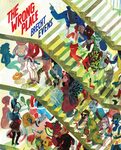
Most of all readers will glory in Brecht Evens's unparalleled translucent painted comics employing inks, gouaches, watercolors which he has developed through a series of graphic novels over the last ftwo decades, beginning with The Wrong Place and then continuing through Making Of, Panther, and crescendoing with his magnificent The City of Belgium (the English language edition of Les Rigoles), all published in North America by Drawn & Quarterly. Here in the pages of The Jellyfish King, Evens confidently displays his mastery over his materials while also extending his artistic reach by experimenting with new materials and methods like etching and lithography, incorporating them into into his comics-making toolkit and further advancing his communicative symbolic framework.
And then, as a bonus value-add, because of Evens’s stunning artistry, the work manages to extend beyond the limits of the graphic novel frame and into history itself, as in apprehending the artistry on display the reader (or this reader, at least) can’t help but see intriguing parallels between heroic organizations and artistic groups (think the surrealists, the cubists, the abstract expressionists, pop artists, et al and within these loose informal groupings, the delimited schools such as Bauhaus and De Stijl – and then, by recursive extension this can be applied to all the arts – literature, poetry, music, architecture…. you name it!)
Evens’s beautiful lettering has been painstakingly recreated for this English edition by François Vigneault (who also worked on the translation together with Evens). Speaking of whom, there’s a fairly in-depth interview with Evens conducted by Vigneault, that includes plenty of sample pages and panels from the work, HERE (but please note that spoilers abound, so perhaps consider saving it to read afterwards).
Take a moment fo get a taste of what's in store by checking out this PDF preview provided by its publisher, D & Q.
And then we've also posted a nice gallery of images of and from the book up on the Copacetic Tumblr, HERE.
Needless to say, RECOMMENDED!