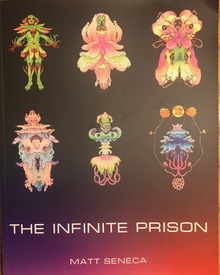
The Infinite Prison is Matt Seneca’s most ambitious and substantial work to date. Intricately plotted and lushly colored, this long-in-the-works 184 page full size perfect bound softcover graphic novel makes for an absorbing, powerful, and disturbing read. Nominally science fiction – it is set in a post-apocalypse Poland (so it seems safe to assume that Stanislaw Lem is somewhere in the thematic mix here?), a number of years (fourteen?) after a nuclear war which wiped out a large chunk (perhaps most?) of humanity, where technology has, somewhat counterintuitively, continued to advance in novel ways – The Infinite Prison also incorporates into the mix aspects of superhero mythologies, particularly those involving genetic mutations leading to enhanced states of being, and their concomitant identity issues, plus a bit of (Polish-inflected) religio-nationalism in the form of a priestly agent of the nation who knits the narrative together. So, suffice it to say: plenty going on here.
The work’s central theme is, as the title implies, that of presenting a confrontation with the sense of unending, ineluctable imprisonment, specifically that engendered by being trapped in the flesh of sexually reproducing beings – the inevitable flipside of which is a yearning for escape. Self-annihilation – whether through nuclear armageddon or personal suicide – is one sure route… but is there another? Seneca here posits the possibility of a path to transcendence and then goes on to chart its course.
For those who prioritize the visual elements and find themselves intrigued – but are wholly unfamiliar with Seneca’s artistic sensibilities – we’d say by way of suggestion (but not diagnosis) that the art is something along the lines of Frank Quitely grafted onto early Michael Kaluta (again, this is just to give unfamiliar readers a sense of what to expect, not a stylistic interpretation)
Also, fans of Anders Nilsen’s Tongues may find themselves on somewhat similar terrain – but less Greek, more Christian-adjacent, and also worth noting here: Seneca’s themes are darker, the action is more visceral and the visuals more graphically violent and sexual.
Michel Fiffe has this to say:
"Seneca has outdone himself by surrendering to an inspired, almost maniacal vision of warring values: harsh, delicate, elegantly measured, playfully reckless. Every mark, every hue, every last sentiment crammed within points to THE INFINITE PRISON being, above all, a personal message to the world in the form of pure comics."