FROM THE ARCHIVE
BRAND NEW COPIES
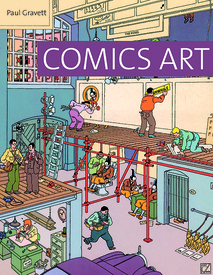
Paul Gravett has long been one of the foremost comics evangelists out there, and this is nowhere more evident in his monograph/sermon on comics, Comics Art. A great one stop volume to get up to speed on how comics came to be and what makes them special.
Here's the Tate's take:
'Richly illustrated and hugely informative' - Rachel Cooke. Comics Art has been selected by the Observer in their Books of the Year list.
'I'm into comics now - and there's no better guide to the undiscovered wonders out there, between hard and soft covers, than Paul Gravett. His Comics Art, published as a gorgeous hardback by Tate, is the culmination of a lifetime's reading, collecting and thinking. There are mind-blowing images on every page turn . . .' Toby Litt of New Statesman picked Comics Art as his book of the year.
Comics are a unique autonomous art form, one that has its own rich traditions that have given rise to a remarkably vibrant contemporary scene. Paul Gravett, the author of Comics Art, is one of the world’s leading authorities on comics culture. In this richly illustrated book he traces the history of comics from the late nineteenth century through to the huge current interest in manga and graphic novels and the explosion of comics on the internet.
Instead of sticking to the familiar Anglo-American-centric bias, Comics Art takes a more international approach. From foundational seminal works such as Rodolphe Töpffer's and Wilhelm Busch's albums, George McManus's Art Deco 'Bringing Up Father' and Alex Raymond's 'Flash Gordon' to the later retro-stylings of Robert Crumb, Gravett traces lines of influence around the world as well as looking at comics as a precursor of cinema. He examines how they have shifted from support of the status quo to offering a voice to more subversive, alternative forces, from 1960s manga in Japan to bandes-dessinées in post-1968 Paris. In today’s comics culture he notes the rise of publications that function as questioning, transgressive outlets for outsider stories and ideas, often silenced in other media. Self-publishing and the internet have given rise to new, autobiographical forms and an increasing number of authors drawn from outside the mainstream, whether sexually, ethnically or politically. He reveals that comics are on the cutting edge of futuristic thinking in communications, internet design, language and semantics, among other fields. Gravett examines the special properties that enable comics to communicate complex ideas and explores the ways that ancient traditional folk art traditions, such as Indian Patua scrolls or gond art, are reinvigorating the form. All around the world, the language of comics is still being invented in the 21st century and Paul Gravett is the perfect guide to this rich and fascinating field.
Since 2003 Paul Gravett has been the Director of the Comica Festival, London’s premier comics festival. He is the author of several books on comics, including Manga: Sixty Years of Japanese Comics (2004), and Graphic Novels to Change Your Life (2005), and is a regular contributor to publications including the Guardian, the Times, the Independent, the Times Literary Supplement, Dazed & Confused, Art Review, European Comic Art, and The Comics Journal.
144 Pages, 8.00 × 10.50 in, 85 color illus. | Hardcover | ISBN: 9780300204018